How This Site Gets Written
Five folders, a Telegram bot and a notepad. How the writing on this site actually happens, why it started as training data for a machine, and what it showed me.
Now days, I see people journaling all the time when I’m out and about, in coffee shops, parks and airports. It’s the same thing that happened with my camera, where once I picked one up I started seeing them on everyone else. There’s a name for it, the yellow car phenomenon, because the day you buy a yellow car is the day the road fills up with yellow cars.
I mostly do the same thing in a code editor, inside the same folder of files that publishes this site. Anyone glancing over my shoulder in a cafe would think I was working, because it looks exactly like writing code. It is a dark window full of small text with a list of files down one side, and what is actually in it is a paragraph about banana bread.
Simply put, this whole site is a folder of text files sitting on my Mac, one file for every page you can read here. There is nothing to log into and no box on a screen where I type a post. When I send that folder up to the internet each file turns into a page, so writing a post and publishing the site are the same action.
It started as an off the shelf blog theme, which gave me posts, an archive and very little else. Everything after that I built on top of it as a need turned up.
- A photo gallery for the pictures I take
- A folder for writing that never publishes
- A way to show one person a post without putting it on the site
- A journal, a page in that same folder of files for any day I write something
- A Telegram bot that files notes straight off my phone
I did not design any of it. Each piece went in when I wanted something the site could not do yet, and the first one went in for a reason that had nothing to do with writing.
The Agent
In December 2025 I built an agent for digitalden.cloud. That is my cloud portfolio and a different site from this one, where I document the cloud work I do, the problems I hit at my job and the things I build to get around them, written up so that someone else can follow the same steps.
I had just learned how to build agents, and there were years of writing sitting on that site with no quick way through it. So the agent read all of it and answered questions, and a visitor could ask instead of hunting through the archive. Putting one on my own site was also a way to show the skill working on something real.
The last thing I wrote in that post was an idea I had for a private version of it, pointed at journals and notes and drafts instead of technical documentation.
A private version of the agent could search information that only I have access to. Journals, notes, ideas, drafts, and planning documents. Eventually, that becomes a personal knowledge system. Therefore, instead of going through folders or searching text files, I could ask questions like: “What was I working on last summer?” or “What were my goals for this year?” and get answers grounded in things I actually wrote.
Grounded is the word doing the work there. It means the agent answers out of documents I hand it rather than out of whatever it picked up in training, so if the answer is not in my own writing, it does not have one. That was the part I wanted, something I could pick at my own brain with. Then I went to build it and found the obvious problem. An agent pointed at my journals needs journals, and at the time I had 35 technical posts about cloud computing and not one sentence about myself.
So I set the blogging site up again from scratch, called it denizyilmaz.cloud, and started writing personal entries to give the machine something to read. The first ones were a creatine study I was running, how I was filming in a low light gym, a chicken dish I eat most weeks and the first game I had played in years. That is why this began, and the reflection came later.
The Folders
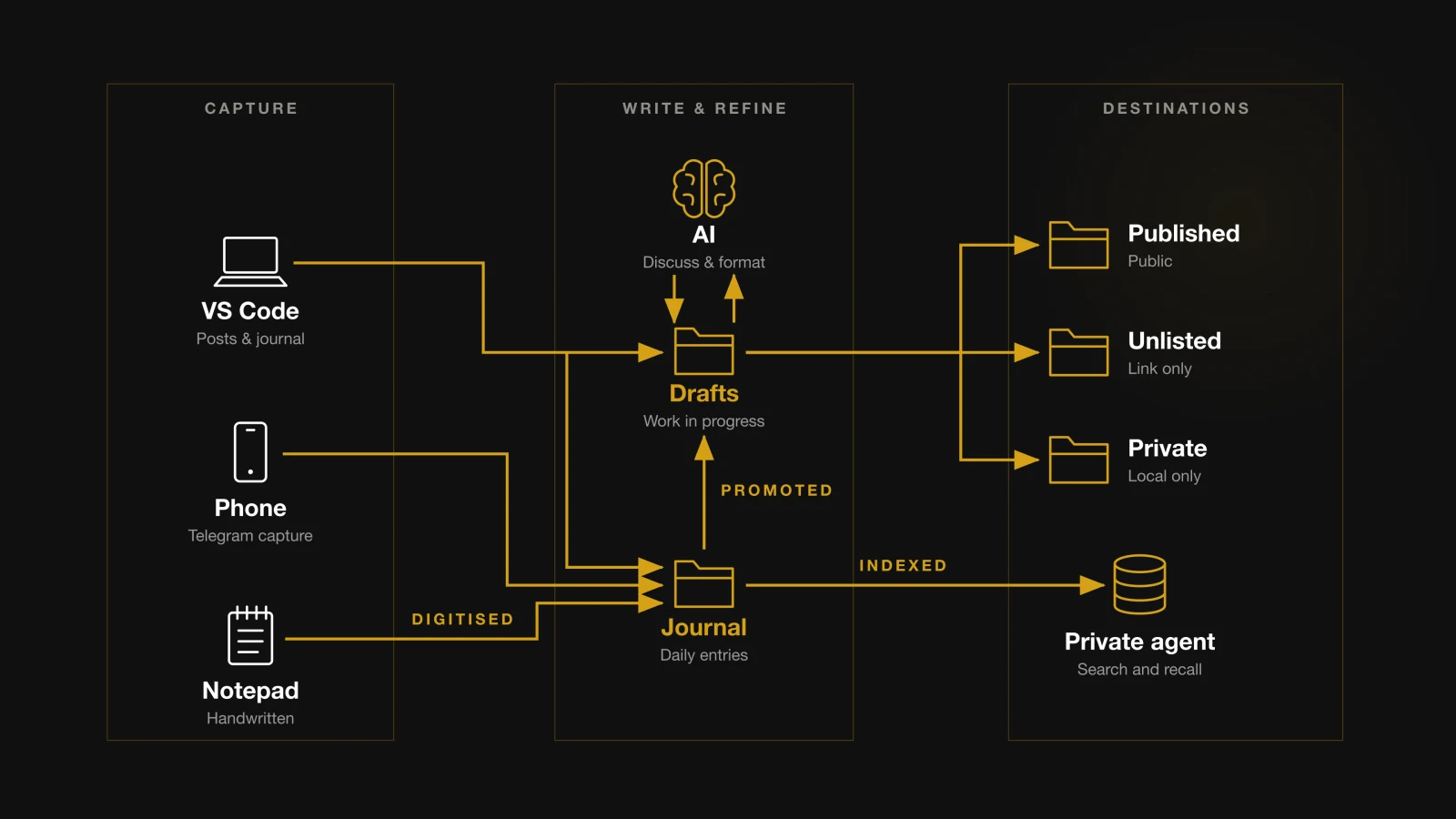
The site is that folder of text files, and inside it are five folders a piece of writing can sit in. A post usually starts in drafts and goes straight out from there. Anything that arrives off my phone goes into the journal first, and most of what goes into the journal stays there and never becomes a post, although it may eventually end up in front of the private agent.
flowchart LR
  W[typed straight in] -->|most posts| D[drafts<br/>becoming a post]
  T[phone] --> J[journal<br/>what I thought that day]
  H[notepad] -.-> J
  J -->|now and then| D
  D --> P[published]
  D --> V[private<br/>never published]
  D --> S[unlisted<br/>sent to one person]
Journal
The journal holds my reflections, a page for any day I feel like writing and nothing at all for the days I don’t. What goes in there is raw thinking, written straight down and never shaped for anybody. It sits in the same place as the posts and never publishes.
Drafts
Drafts is where a piece gets shaped, a recipe or a trip I am still working out. It is also where the AI comes in, because I talk the thing through and it comes back with my formatting already on it. I rarely finish one in a single sitting, so it sits there and I come back to it.
Published
Published is what happens once I am satisfied with it.
Unlisted
Unlisted is for a post I want one person to read and nobody else to come across. It gets a real address on the site that nothing links to, so it stays out of the archive and out of search, and the person I send it to opens it like any other page.
That is not the same as private. Anyone holding the link can read it, which is why nothing goes in there that would be a problem if the link got passed on.
Private
Private is the one that made the rest possible. It holds writing I am never going to publish, and it is not protected by me remembering to be careful. The settings that build this site are told to skip that folder, and those are the settings that run every time the site publishes, so nothing in there is ever turned into a page at all. There is no private address sitting on the internet waiting to be guessed, because there is no page.
When I want to read those entries back I switch that setting on here on my Mac and they come out as proper pages, with the same styling as everything else on the site, which is a far nicer way to read them than scrolling a document. That setting never travels with the site.
That is why I can write honestly in there. If private only meant a folder I had promised myself not to publish, I would still be writing with one eye on the publish button.
The Layer Underneath
I looked at how my recent posts arrived. The site keeps a record of every save I have ever made, and most posts showed up in one or two of them, occasionally four, which is the signature of a finished piece that was written somewhere else.
That somewhere else was a chat window. I use an AI for most things now, working out camera settings while I was teaching myself photography, putting a training block together, refining a recipe before I cook it. The Swedish cake I baked in May came out of asking it what else was like the Finnish pie I had made in February. Writing posts is one more of those.
I am hands on about it. I would talk a thing out, go away and cook it or shoot it or build it, come back with what actually happened, and go round again. After enough passes there would be a post with my formatting already on it. The post went into the folder, and the back and forth that produced it, the part where I was still working out what I thought, existed only in a conversation log. The record held every version of the polished writing and none of the thinking.
So I added the journal, and a shortcut that opens today’s page with the date already at the top. Nothing in there is written for anybody else, and that is the only thing separating it from a post. If I come back to the same page later in the day it stamps the time, so a day reads in order without the file pretending it was all written at once.
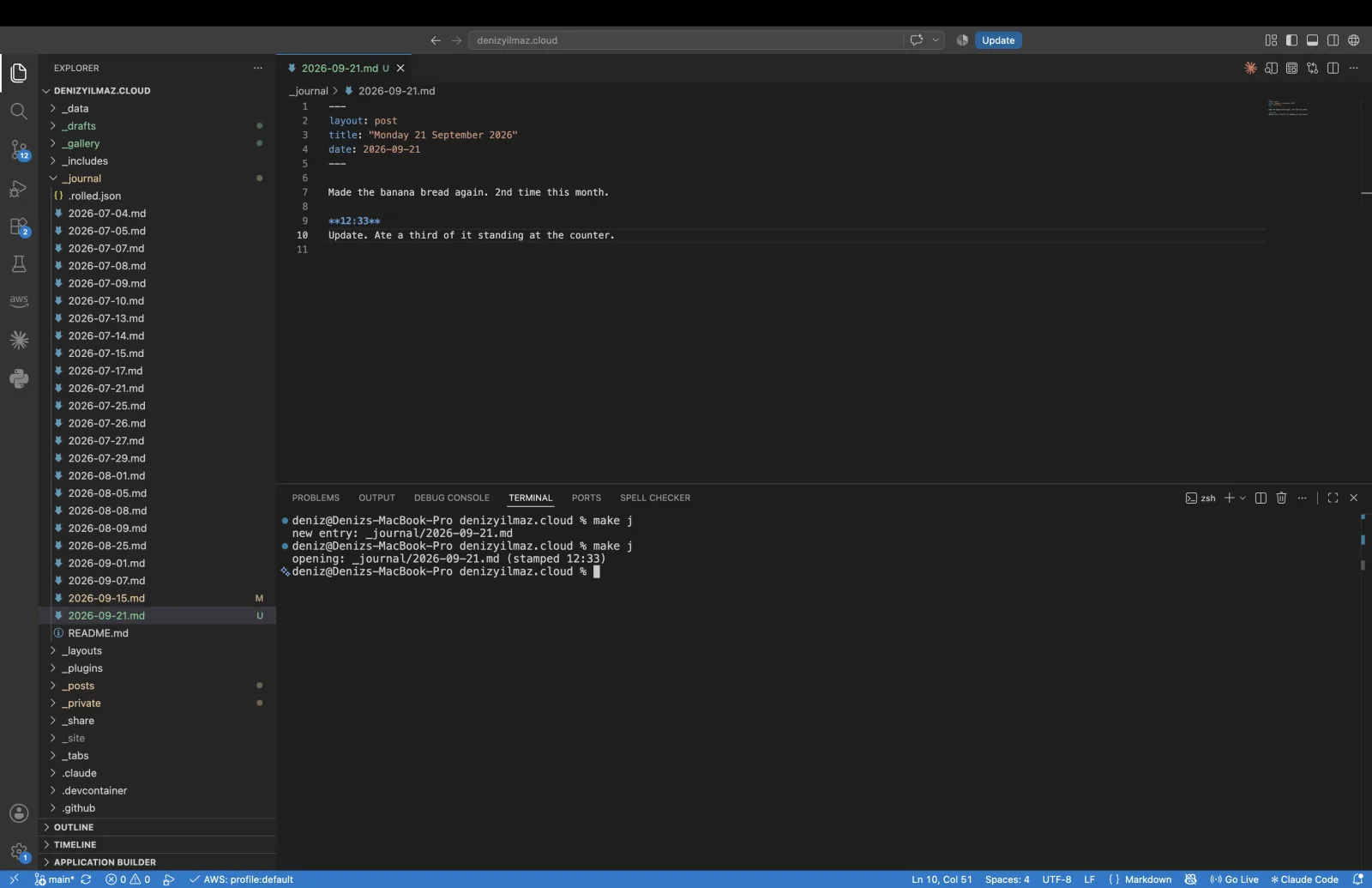 A journal entry opens with the date already at the top, and a second visit the same day adds a time stamp above the new writing.
Then there is the phone. I have a Telegram bot that files whatever I send it straight into the folder with the time on it. It has been running since July and it is the only part of this that works while I am out.
One more shortcut folds every one of those captures into the journal entry for the day it was sent, not the day I run it. I can leave it a month and the dates stay honest. When I ran it the first time it filed 36 captures into 22 entries going back to July, and one of them turned out to be 700 words about a day in Bodrum that had been sitting in a file I was never going to open again.
The shortcuts are four lines I type into a terminal, and they are the only part of this that is not just moving a file between folders.
| Command | What it does |
|---|---|
make j | Opens today’s journal page with the date already at the top |
make roll | Files every phone capture into the entry for the day it was sent |
make journal | Renders the journal as pages so I can read it back here |
make p | Does the same for the private folder |
The Pattern
None of the above is the interesting part. This is.
About six months into writing these entries I was in Bodrum, typing up a post about buying a camera and teaching myself photography. Halfway through it I realised I had bought the camera completely on impulse. Then I noticed the shape of what came after, the way I went deeper and deeper into it and could not stop, and that it was identical to how I had got into cloud engineering. The starting points were different and everything after them was the same.
I was not looking for that. It fell out of the act of writing the sentence down, and I said so in the post itself.
I only really discovered this about myself from writing about it. Documenting the journey, then stepping back and realising the cycle looked familiar. If I did not write, I would never have seen it.
That is from How I Got Into Photography, and it is the closest I have come to explaining why any of this is here. I document things obsessively, not for an audience, but because writing a thing down is how I work out what I think about it.
So the writing did not record the pattern. The writing is what made it visible.
The Notepad
I have started doing some of the journal on paper, not instead of the editor, alongside it, and I am really starting to enjoy writing by hand. The first entry was on a bench in Holland Park on 16 September, and I am keeping a running log of what changes now that I am doing it this way.
The people with the notepads have something I do not. There is no screen, no autocomplete, no model sitting next to them offering a better sentence. Their first draft is entirely theirs, and mine increasingly is not, and I can feel the pull of that every time I write in that folder with a chat window open beside it.
The first thing paper taught me was that I write too fast. I took my typing speed straight to the pen and my hand hurt before I had finished the page. A pen cannot keep up with a thought the way a keyboard can, so the thought has to be held while it is written out, and holding it is what turns recording into reflecting.
None of those pages are in the journal yet. I will photograph them in batches at some point and I am in no rush about it, but I will do it eventually, because the plan is to give the agent the lot. Once it can read the handwritten entries as well as the typed ones I can ask it about them and think through them with it, instead of only ever reading them back myself.
That is where the entries that never become posts finally go. The ones I shape into a draft are the small end of it, and everything else just sits in the journal, which is the part the agent would be most use on, because it is the only record of what I actually thought on the day.
flowchart LR
  H[notepad] -.->|photographed, eventually| J[journal]
  J -->|now and then| D[drafts] --> P[published]
  J -.->|everything else| A[private agent]
The setup today is five folders, a Telegram bot and a notepad, and it has produced 53 posts in ten months and a journal that reaches back to July. It began because I wanted a machine to read my writing, and it has ended up with a pen in my hand, which I would not have seen coming ten months ago.
When the notebook is full I will digitise every page, put the whole journal in front of the agent, and finally get to ask it what all of that writing says back.
There are a few things I want out of that.
- Recall, getting back something I wrote and forgot
- Connections between entries written weeks apart
- Answers about my own life taken from what I wrote at the time rather than what I remember now
- A question I can ask instead of opening files one at a time
Until then I am one of the people in the park with a notebook.