The Notebook
After nine months of typing my journal I am taking the first pass to paper, and this is the running log of what changes when I do.
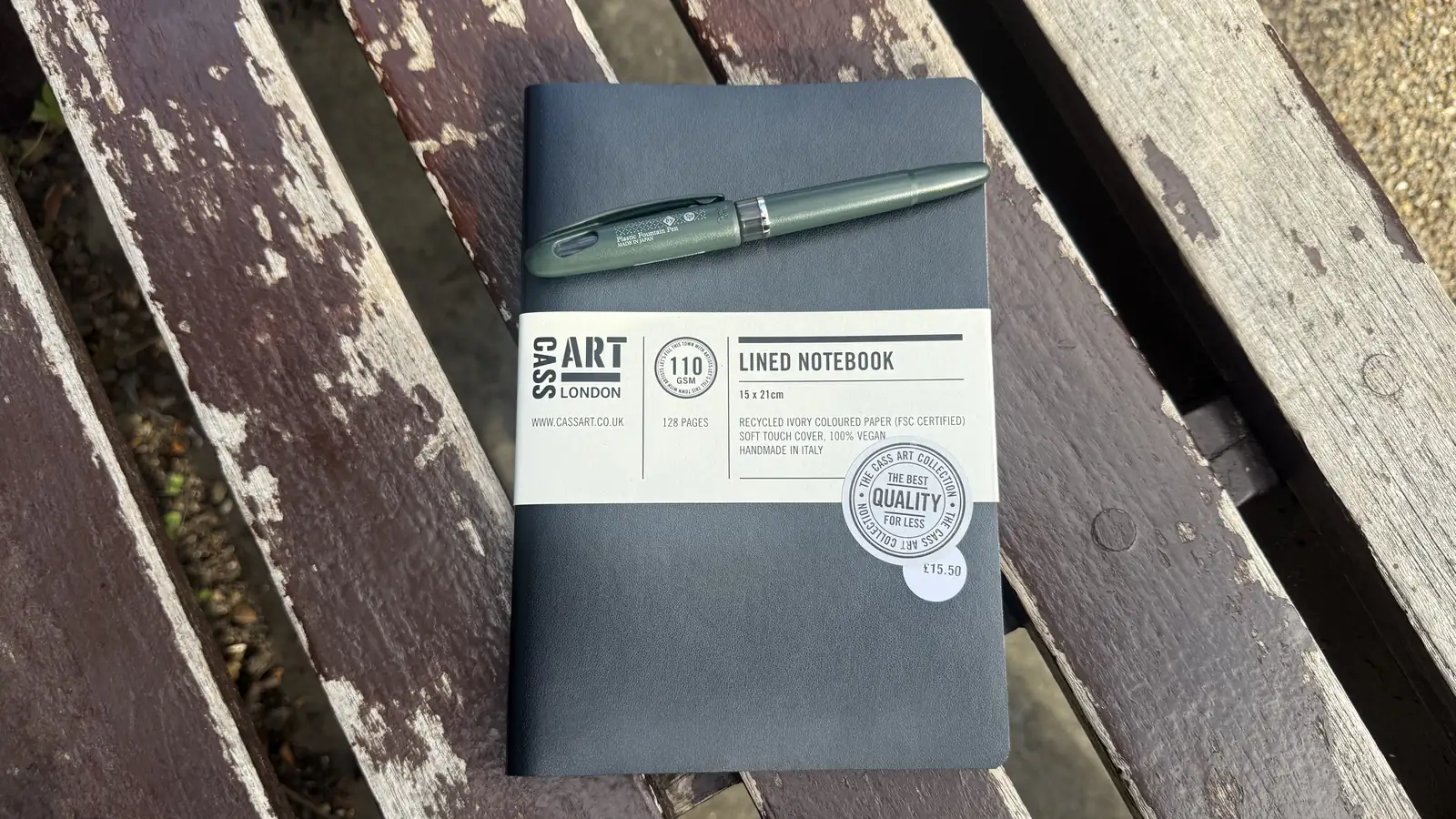
Today I am going to the shop for a notepad and a pen, then to Holland Park to write the first entry by hand. Everything I have written for the last ten months has been typed.
So this is the log of what it is actually like to do it by hand.
The Build Up
This did not start with a decision. It started with noticing.
In July I left myself a note after writing a long journal entry. It said I missed writing with a pen and paper, and that typing on a phone or keyboard is not pleasant. The same note had the catch in it already, which was that anything on paper would then need digitising.
I kept seeing people journaling on little notepads when I was out. I suppose I noticed it because I was doing the same thing myself, on my laptop. Then at the end of August a woman I met, who keeps paper diaries, told me I was doing it wrong. Handwriting or nothing. She likes watching the pages go yellow.
I did not disagree with her. I just was not ready then.
I am not doing handwriting or nothing though, because I am keeping the digital side. The paper is for the first pass and everything still gets typed up afterwards.
That second half already works. Every entry ends up as a plain text file in the same repository that publishes this site, and the folder it sits in decides what happens to it. Some never build into a page at all and stay on this laptop. Some become posts.
Not everything starts as a journal entry either. Some posts I type straight into a draft, with nothing handwritten and nothing in the journal before it. This is just another way in.
flowchart LR
  H[paper<br/>first pass] --> J[_journal<br/>typed up]
  J --> N[never builds<br/>stays on the laptop]
  J --> D[_drafts]
  T[typed straight in] --> D
  D --> P[_posts<br/>published]
Underneath that I have been craving the physical thing for a while. I type all day for work, then type my journal, then type my posts. I used to love writing by hand at school, and somewhere along the way I stopped. I am excited to get back to it.
The Point
I am not doing this because writing by hand rewires your brain. The research there is thinner than the headlines suggest and none of this rests on it.
I am doing it because the journaling itself has already done something. Nine months of typed entries showed me patterns in how I behave that I would not have noticed otherwise, and I only saw them because they were sitting written down where I could read them back. The reflecting has been good for me.
So the writing works. I am ready to take it further, and what I do not know is whether the pen changes anything. That is what this log is for.
The Kit
I spent an afternoon finding it.
There is an art shop in Kensington called Cass Art that I always walk past and always thought looked good, and today I had a reason to go in. I found a notebook almost straight away and picked it up because of how smooth the cover was, then saw £15.50 on the front. Then I read the label, which said recycled ivory paper, soft touch cover, 100% vegan, FSC certified and handmade in Italy.
I put it back. I wanted to see Tokyo House down the road first, because I like Japanese products and thought I might do better.
Their notepads were no good. Their pens were another thing entirely, and I was in there for half an hour working through every one of them. I came out with a plastic fountain pen marked made in Japan, for £7.99. I have always liked fountain pens and being left handed has always ruled them out, because my hand drags straight through the wet ink. This one does not smudge, and the colour comes up properly on the page.
Then I walked back to Cass Art for the notebook, because I had not stopped thinking about that cover. The pair came to £23.49.
The Log
One entry at a time, with whatever I noticed that day.
16 September, Holland Park
My hand hurt, and it came on faster than I expected.
The reason is that I was trying to write too fast. I type quickly and I brought that habit straight to the pen without noticing, so I spent the whole entry racing a page that does not move at that speed.
Why going slower helps
Handwriting is slower than typing, so the hand cannot keep pace with the thought. At a keyboard a sentence can be recorded before it has finished forming. With a pen the thought has to be held while it is written out, and holding it is what turns recording into reflecting.
I want to focus more on what I am writing and learn to slow down. That is next.
25 September, Kahve Dünyası, Bodrum
After ten days of writing in the journal most days, I have learned to slow down and enjoy the writing more.
At the start I was rushing to finish my point. Now I do not try to get it all down in one go. I pick up from where I last left off.
I have also noticed that I sometimes go off on a tangent, and a few paragraphs later I come back to the original point. I enjoy this. I feel like the tangents are where the more interesting, random thoughts come out, and they are somehow connected to the point I started with.
What a tangent is
In writing, a tangent is a move away from the main point onto something related to it. The word comes from geometry, where a tangent is a straight line that touches a curve at a single point and then continues in its own direction. It comes from the Latin tangere, to touch. So a tangent in a journal touches the point and then heads somewhere else.
29 September
I started out writing about my day and went off on a tangent. This one brought up childhood memories, and from there I was writing some deep stuff for the first time.
Most of my writing so far has been positive, about the good things. This was more emotional. It made me feel a certain type of way while I was writing it, and I wrote it anyway.
Then something happened as I finished up and left. On the walk I felt much better, like a weight off my shoulders.
It literally felt like that.
Why writing it down can feel lighter
Research on expressive writing, which the psychologist James Pennebaker started in the 1980s, found that people who wrote about emotional experiences tended to feel better over the following weeks. The effect is small and does not hold for everyone, and many people felt worse straight after writing before they felt better. Separate brain imaging work suggests that putting a feeling into words quietens the brain’s alarm response to it. Walking lifts mood on its own as well, so the walk afterwards may have helped too.