Turkish Müçver
Traditional Turkish courgette fritters adapted for UK ingredients. Full method, nutrition breakdown, and notes from a home cook.
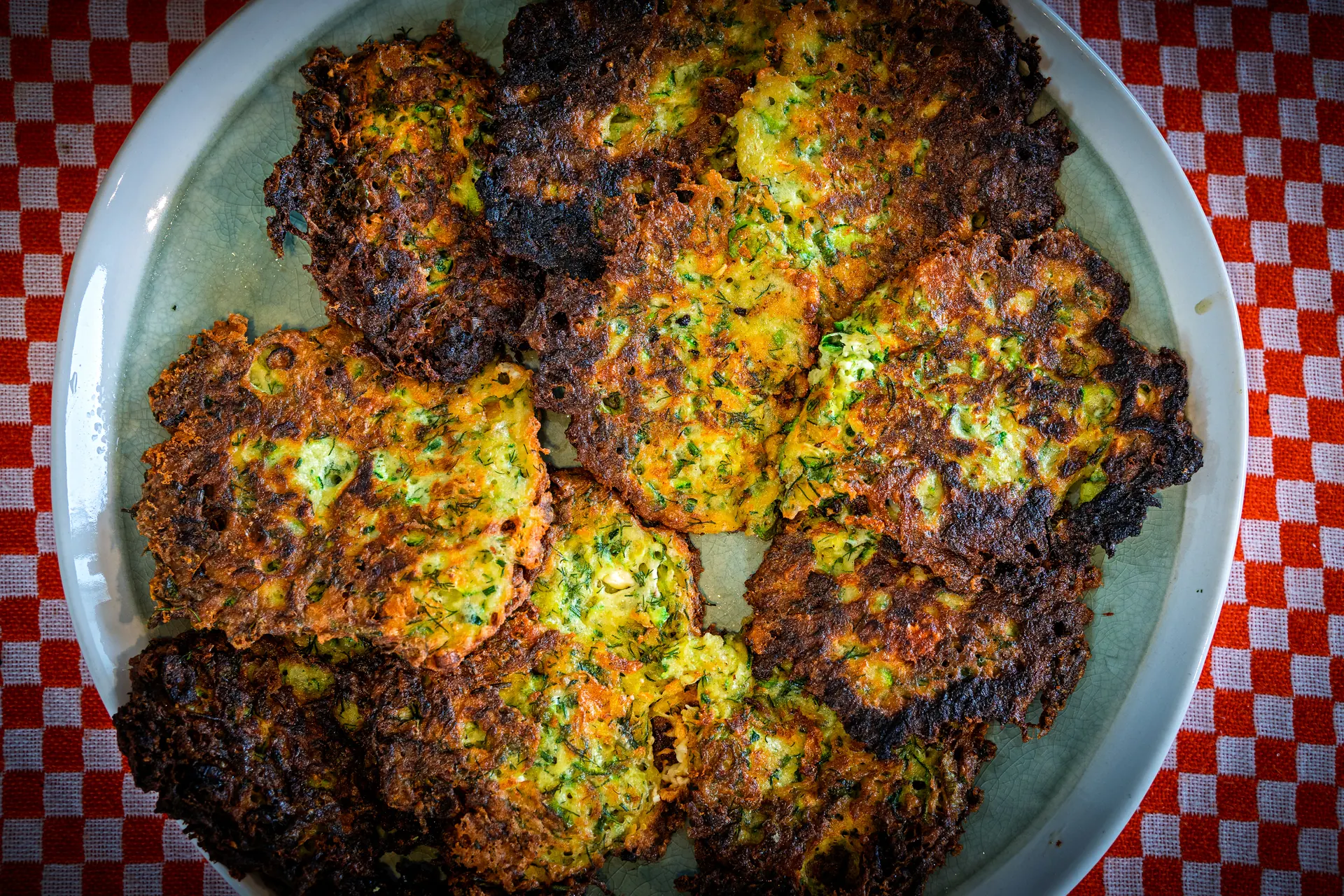
Müçver is a Turkish courgette fritter. It is grated courgette held together with white cheese, dill, egg and a small amount of flour, fried in shallow oil and eaten with garlic yoghurt. The word itself just means fritter, and when someone in Turkey says müçver without specifying what kind, they mean courgette.
My mum used to make it sometimes. I never thought of it as a recipe, so this is the first time I have written the method down. Squeezing the water out of the courgette is important, and using too much flour turns it dense and doughy.
Why Courgette
Courgette is not a flashy vegetable. Nobody gets excited about it, however, for a fritter base it is hard to beat because it is mostly water, which means the vegetable-to-batter ratio stays high after you squeeze the liquid out. You are eating mostly vegetable with just enough flour to hold it together.
Courgette vs Other Common Vegetables
| Nutrient (per 100g) | Courgette | Potato | Carrot | Spinach |
|---|---|---|---|---|
| Calories | ~17 kcal | ~77 kcal | ~41 kcal | ~23 kcal |
| Protein | ~1.2g | ~2.0g | ~0.9g | ~2.9g |
| Carbohydrates | ~3.1g | ~17.5g | ~9.6g | ~3.6g |
| Fibre | ~1.0g | ~2.2g | ~2.8g | ~2.2g |
| Sugar | ~2.5g | ~0.8g | ~4.7g | ~0.4g |
| Vitamin C | ~18mg | ~20mg | ~6mg | ~28mg |
| Potassium | ~261mg | ~421mg | ~320mg | ~558mg |
Courgette is the lowest calorie option on this list by a wide margin. It also brings decent potassium and vitamin C without loading the fritter with starch the way potato would. Potato makes a heavier, denser fritter. Carrot adds sweetness and colour, which is why some Turkish recipes throw in a small one, but it is not the star. Spinach works in a different kind of fritter entirely.
The point is that courgette keeps the fritter light. The flavour comes from the dill, the feta, and the frying, not from the vegetable itself.
Müçver vs Other Turkish Meze
If you are comparing müçver against other things you might find on a Turkish meze spread, here is where it sits. Sigara böreği will get its own post next, so this table gives some early context for that too.
| Meze (per serving) | Calories | Protein | Carbs | Fat | Fibre |
|---|---|---|---|---|---|
| Müçver (4 fritters, pan-fried) | ~280-320 kcal | ~12g | ~28g | ~16g | ~2.5g |
| Sigara böreği (3 rolls) | ~350-400 kcal | ~10g | ~30g | ~22g | ~1g |
| Hummus (100g) | ~170 kcal | ~8g | ~14g | ~10g | ~6g |
| Kısır (100g) | ~140 kcal | ~4g | ~22g | ~5g | ~4g |
| Cacık (100g) | ~50 kcal | ~3g | ~4g | ~3g | ~0.5g |
Müçver and sigara böreği are close in total calories, but the profile is different. Müçver has more protein because of the eggs and feta, and more fibre because of the courgette. Sigara böreği is higher in fat because the yufka pastry absorbs more oil during frying. Hummus is the most protein-dense option per calorie. Kısır is the most balanced. Cacık is basically a condiment.
None of these are high-protein meals on their own. If you are lifting and tracking, müçver works best as a side alongside something like grilled chicken, lamb, or a big bowl of garlic yoghurt to bring the protein up.
Ingredients (approx. 15-16 fritters at 30-40g each)
| Ingredient | Brand / Source | Amount |
|---|---|---|
| Courgettes (green) | Waitrose fruit & veg | 3 medium (~450g) |
| Fine sea salt (for sweating) | Any | 1 tsp |
| White cheese (beyaz peynir) | Süt Diyarı Piknik 60% from Turkish shop, or Waitrose Greek feta | 100g |
| Fresh dill | Waitrose herbs | 1 small bunch (~20g) |
| Fresh flat-leaf parsley | Waitrose herbs | 1 small bunch (~15g) |
| Spring onions | Waitrose | 4, finely sliced |
| Large eggs | Free range | 2 |
| Plain flour | Waitrose own label | 4 tbsp (~35g) |
| Baking powder | Any | ½ tsp |
| Black pepper | Any | ½ tsp |
| Refined avocado oil (for frying) | Any (sunflower oil also works) | 200ml to start, 30ml top up between batches |
Fresh dill is the main herb in müçver. Dried dill is weaker and flatter, and it will not give the same flavour, so use fresh.
If you have access to a Turkish shop, get beyaz peynir instead of supermarket feta. Süt Diyarı Piknik Çiftlik Peyniri at 60% fat is a good option. It is softer and creamier than Greek feta, which means it distributes through the batter more evenly instead of leaving sharp salty pockets. The 60% version has enough fat to crumble and melt into the fritter properly. The 40% tends to be drier and more rubbery. If the cheese tastes very salty out of the tub, soak it in cold water for 10-15 minutes before crumbling it into the batter. If you cannot get to a Turkish shop, standard Greek feta from Waitrose works fine.
Squeezing the courgette
This is the most important step in the entire recipe. Grated courgette is full of water. If you skip the salting and squeezing, the batter will be runny, you will need more flour to hold it together, and the fritters will be soft and heavy instead of crispy and light. Do not rush this.
Method
Step 1: Grate and salt the courgettes
Grate the courgettes on the coarse side of a box grater. That is the side with the largest holes, usually around 6-7mm. Do not use the fine side or you will end up with mush instead of shreds. You do not need to peel them. Use full length strokes from top to bottom with light pressure. This gives you longer, more even shreds that hold together in the fritter. Short quick strokes produce uneven bits and the small pieces turn to pulp. Stop when you get down to the last small nub rather than grating your knuckles into the mix. Tip the grated courgette into a colander or sieve set over a bowl, sprinkle with 1 tsp of fine salt, toss it through, and leave it for 10 minutes.
Step 2: Squeeze the water out
After 10 minutes, take handfuls of the grated courgette and squeeze as hard as you can over the sink or a bowl. You want to get as much liquid out as possible. A clean tea towel works well here. Wrap the courgette in the towel, twist the ends, and wring it out. The drier the courgette, the crispier the fritter.
How much water comes out
More than you expect. Three medium courgettes will release roughly 100-150ml of liquid. If you skip this and go straight to mixing, the batter turns into soup and no amount of flour will save it.
Step 3: Mix the batter
Transfer the squeezed courgette to a large bowl. Crumble in the feta. Add the finely chopped dill, parsley, and spring onions. Crack in the eggs and mix everything together. Then add the flour, baking powder, and black pepper. Stir until it comes together into a thick, rough batter.
Do not overmix and do not add extra flour unless the batter is genuinely too wet. The flour is there to bind, not to bulk it out. Too much flour and you lose the lightness.
Step 4: Fry immediately
Heat the oil in a large frying pan over medium heat. What you are aiming for is a depth of 3 to 5mm, and the volume that produces depends on the diameter of the cooking surface rather than the rim, because most pans slope. Measure the flat base of the pan, then pour the oil from a jug.
| Cooking surface | 3mm | 4mm | 5mm |
|---|---|---|---|
| 22cm (28cm ProCook stainless) | 114ml | 152ml | 190ml |
| 26cm (Lodge 12 inch cast iron) | 159ml | 212ml | 265ml |
Four millimetres is enough for a 30-40g fritter, so the Lodge takes 200ml to start. This is far more oil than searing or sautéing needs, but fritters have to sit in the oil rather than on a greased surface. Test the temperature by dropping a tiny bit of batter in. If it sizzles immediately, the oil is ready.
Drop heaped tablespoons of batter into the pan and flatten them slightly with the back of the spoon. Do not overcrowd the pan. Four or five at a time is enough in a 28cm pan, six or seven in the 12 inch Lodge. Too many fritters will drop the oil temperature and they will absorb more oil instead of crisping up. Top up the oil between batches if it is getting low.
Oil choice
Refined avocado oil is ideal here. High smoke point, neutral flavour, handles medium heat without breaking down. Sunflower oil is the traditional Turkish choice and works just as well. Do not use extra virgin olive oil for frying. It will smoke and taste bitter. A light or refined olive oil is fine if that is what you have, but avocado or sunflower are better options.
Pan Choice
| Aspect | Stainless Steel | Cast Iron | Non-Stick |
|---|---|---|---|
| Crust quality | Crispier, more golden | Crispiest, most even | Softer, lighter colour |
| Oil needed | ~150ml in a 22cm base, top up every batch | 200ml in a 26cm base, top up every batch | ~100ml, less topping up |
| Sticking | Some sticking on every flip | Little once the seasoning is established | No sticking |
| Patience required | High. Do not touch for 3 minutes | High. Do not touch for 3 minutes | Low. Can move them earlier |
| Preheat | 1 min dry, then 20 sec with oil | 4-5 min dry, then 60-90 sec with oil | Less critical |
| Heat recovery | Drops when cold batter goes in | Holds temperature through a full batch | Drops when cold batter goes in |
| Cleanup between batches | Scrape stuck bits before next round | Scrape stuck bits, re-oil after washing | Wipe and go |
| Overall | Good result, more effort | Best result, slowest to heat | Easier, slightly less crispy |
If using stainless steel, preheat the pan on medium, let the oil heat until it shimmers, drop the batter in and leave it alone. The fritters will release naturally once the crust forms. If you try to flip too early they will stick and tear apart.
Cast iron is preheated the other way round, dry first and oil second. The metal conducts heat badly, so it needs 4 to 5 minutes on medium-low to come up evenly, and oil poured in at the start would sit in the pan for that whole time while the base ran ahead of it. A 12 inch pan also overhangs most hob rings, which means the centre heats first, so lift and rotate it a couple of times during the preheat or the outer fritters will cook slower than the middle ones. Test the pan with a few drops of water. They should skitter and roll rather than sit and boil. Then pour in the 200ml, give it 60 to 90 seconds, and check with a drop of batter or a thermometer reading 170 to 180°C. Leave the dial where it is when the fritters go in, because absorbing that drop without losing the crust is what cast iron is for.
Do not dry preheat on high
Four or five minutes on medium-low is enough to bring the pan up. A long dry preheat on full heat thins the seasoning over time, and refined avocado oil poured onto a pan that hot will smoke before the batter goes anywhere near it.
Step 5: Cook until golden
Fry for about 3 minutes on the first side until the edges are golden and the base is set. Flip and fry for another 2-3 minutes on the other side. The fritters should be deep golden brown on both sides and cooked through in the middle.
Step 6: Drain
Transfer the cooked fritters to a plate lined with kitchen paper. The paper absorbs the excess oil. Let them sit for a minute before eating.
The batter releases more water as it sits
This is normal. As you fry batches, the remaining batter in the bowl will get wetter. Give it a stir before scooping the next batch and let the excess liquid drain off the spoon before it hits the oil.
Garlic Yoghurt Dip
This is the standard accompaniment. It takes 30 seconds to make and it brings the protein up if you are tracking.
| Ingredient | Amount |
|---|---|
| Greek or Turkish yoghurt (full fat) | 150g |
| Garlic, crushed | 1 clove |
| Fine sea salt | 1 pinch |
| Dried mint (optional) | ½ tsp |
Crush the garlic into the yoghurt, add salt, stir. That is it. A pinch of dried mint on top is traditional but optional. Make it ahead and let it sit in the fridge for 10-15 minutes so the garlic mellows slightly.
Nutrition — Per Fritter (15-16 fritters at 30-40g, pan-fried)
| Macro | Amount |
|---|---|
| Calories | ~70-80 kcal |
| Protein | ~3g |
| Carbohydrates | ~7g |
| Fat | ~4g |
| Fibre | ~0.6g |
| Sugar | ~1g |
Per Serving (4 fritters)
| Macro | Amount |
|---|---|
| Calories | ~280-320 kcal |
| Protein | ~12g |
| Carbohydrates | ~28g |
| Fat | ~16g |
| Fibre | ~2.5g |
| Sugar | ~4g |
With Accompaniments
| Serving option | Additional kcal | Additional protein |
|---|---|---|
| + 100g garlic yoghurt dip | ~95 kcal | ~5g |
| + squeeze of lemon | ~2 kcal | 0g |
| + extra crumbled feta (30g) | ~80 kcal | ~4.5g |
These figures assume oil held at 170 to 180°C. Oil that has dropped below temperature goes into the fritter instead of staying out of it, and a batch fried too cool comes in nearer 8g of fat and 110-120 kcal per fritter. The way to keep the numbers honest is to keep the pan hot rather than to use less oil.
Four fritters with garlic yoghurt gives you roughly 380-420 kcal and 17g protein. That is not a high-protein meal by any stretch, but it is a reasonable snack or side. Pair it with grilled chicken or lamb and it becomes a proper plate.
Observations
| Attribute | Result |
|---|---|
| Texture | Crispy exterior, soft and light inside with visible courgette shreds |
| Crispiness | Best in the first 5-10 minutes, golden and crunchy when drained properly |
| Flavour | Dill-forward with a creamy, mild saltiness from the cheese. Garlic yoghurt rounds it out |
| Dill level | Right. One bunch was enough to carry the flavour without overpowering |
| Cheese (Süt Diyarı piknik 60%) | Good call. Distributed evenly through the batter, no sharp salty pockets like supermarket feta gives |
| Oil absorption | Moderate. Kitchen paper caught the excess. Not greasy when eaten |
| Stainless steel pan | Crispy result, but required more oil and patience |
| Lodge 12 inch cast iron | Better crust, less sticking, six or seven fritters a batch. Slow to preheat and drinks 200ml of oil |
| Fritter size | 30-40g preferred. 50g was too thick, lost the crust-to-centre ratio |
| Difficulty | Low — grate, squeeze, mix, fry |
First Cook: Stainless Steel
This was the first time I made müçver on stainless steel. It was a 28cm ProCook stainless steel pan with refined avocado oil.
What Happened
The first batch stuck. Hard. The pan was too hot after a 2-minute preheat on setting 4, and I did not use enough oil. One tablespoon is what I normally use for everything on this pan, but shallow frying fritters needs significantly more. The batter hit the surface, seized, and fused to the steel.
The fix was more oil and finding the right heat. Six tablespoons of oil in the pan gave roughly half a centimetre of depth, which is what the fritters need to cook properly and release from the surface. Setting 4 on my hob worked, but I had to reduce the preheat time to about 1 minute dry, then 20 seconds with oil, to stop the pan building up too much heat before the batter went in.
The Flip
Even with the right oil level and temperature, the flip was never 100% clean. A small amount of batter stuck to the pan surface on every batch. This is just how stainless steel works with wet batter. The fritters held together and came out golden and crispy, but each batch left residue on the pan that needed scraping off before the next round.
The key is patience. Do not touch the fritters for a full 3 minutes after they hit the pan. They stick initially and release on their own once the crust forms. If you nudge too early, they tear.
Between Batches
The oil level drops after every batch. The batter absorbs it. I topped up with another 2 tablespoons before each new round and let it heat for 30 seconds before adding more fritters. Any stuck bits from the previous batch got scraped to the side with the spatula and scooped out. Small bits can stay, but bigger pieces will burn and go bitter.
Second Cook: Lodge 12 Inch Cast Iron
The stainless steel produced a good fritter, but the sticking and the constant oil management made the process more work than it needed to be. So the second cook went into a Lodge Original 12 inch cast iron skillet, the largest pan I own. The 12 inch rim sits on a cooking surface of about 26cm, wider than the stainless pan, which takes six or seven fritters a batch instead of four or five and needs 200ml of oil to reach 4mm rather than the 150ml that covers the smaller base.
The Oil Spat
The pan went on dry for 5 minutes, then the 200ml went in and immediately spat oil across the hob. Splatter like that is water hitting hot oil, either from a pan that was not completely dry or from the jug. The fix was taking the pan off the heat, letting it settle, wiping the hob down, and going back on at a lower setting.
That lower setting turned out to be too low. The first fritters took well over 4 minutes a side instead of the 3 the stainless pan needed, and a fritter sitting in oil below temperature absorbs it instead of crisping. Nudging the dial up one notch and giving the pan a minute to recover fixed it, and from there the fritters came out better than anything the stainless pan produced.
Test the pan with water, test the oil with batter
A few drops of water on a dry pan should skitter and roll rather than sit and boil. Once the oil is in, never use water again. A small drop of batter should sizzle the moment it lands.
Where the Oil Went
Two or three batches in, the pan was dry. Some of that is unavoidable, because 15 to 16 fritters will absorb 80 to 100ml between them however well you cook, and more goes onto the kitchen paper and stays as a film on the pan. The rest came down to two things.
Cool oil is absorbed rather than sealed out. A fritter dropped into oil at 175°C boils off its surface moisture fast enough to form a crust that keeps the oil out, and the same fritter at 150°C soaks instead. The slow start cost more oil than any other part of the cook.
A wide pan also drains faster than a narrow one. Losing 90ml across a 26cm base drops the depth by 1.7mm, so one batch took the pan from 4mm to roughly 2mm and the second took it to nearly nothing. The stainless pan loses depth more slowly for the same volume because the base is smaller.
So the top up is not something to do when you notice the pan looking low. Pour 40ml down the side before every batch and give it 30 seconds to come back up before the fritters go in.
Stainless Steel vs Cast Iron
| Aspect | 28cm ProCook Stainless | Lodge 12 Inch Cast Iron |
|---|---|---|
| Crust | Crispy, golden | Crispier and more even |
| Fritters per batch | 4-5 | 6-7 |
| Oil to start | ~150ml over a 22cm base | 200ml over a 26cm base |
| Oil top up | Every batch | Every batch, 40ml, before rather than after |
| Preheat | 1 min dry, 20 sec with oil | 4-5 min dry, 60-90 sec with oil |
| Heat recovery | Drops when cold batter goes in | Holds through a full batch once up to temperature |
| Sticking | Some on every flip | Noticeably less |
| Time to get right | Quick | Slow, and the first batch pays for it |
| Overall | Good result, constant management | Better result, needs the temperature set properly first |
Cast iron won on the fritter and lost on the setup. The pan takes five times as long to preheat, holds enough heat that a wrong setting stays wrong for several minutes, and swallows a third more oil to reach the same depth. What it gives back is a fritter with an even crust that releases from the surface instead of tearing.
Müçver is best eaten immediately. They are at their crispiest in the first 5-10 minutes out of the pan. They are still good at room temperature, and some people eat them cold from the fridge, but the texture changes. The exterior softens and it becomes more like a dense vegetable pancake than a fritter.
If you want to reheat leftovers, do it in a hot oven at 200°C fan for about 10 minutes on a wire rack over a baking sheet. This keeps the bottom from going soggy. The microwave will make them soft. Do not use it.
They freeze well if you need to batch cook. Freeze them flat on a tray first so they do not stick together, then transfer to a freezer bag once solid. Reheat from frozen in the oven at 180°C fan for 12-15 minutes.
Summary
| Detail | Value |
|---|---|
| Origin | Traditional Turkish home cooking |
| Adapted for | UK ingredients (Waitrose + Turkish shop) |
| Yield | ~15-16 fritters at 30-40g each |
| Cook time | ~15-20 minutes (plus 10 min sweating) |
| Calories per fritter | ~70-80 kcal |
| Calories per serving (4) | ~280-320 kcal |
| Best served with | Garlic yoghurt dip |
| Pans used | 28cm ProCook stainless steel, then a Lodge 12 inch cast iron |
| Oil per cook | 200ml to start in the Lodge, 40ml before every batch |
Documented April 2026. Cast iron cook added September 2026.