Documenting My ADHD Assessment
How building an AI project led to six months of journaling, recognizing patterns in my behavior, and eventually calling the GP for an ADHD assessment.
The Agent and the Patterns
I got to this point today because of an AI project. It started out as a standard lesson I was building for work about Amazon Bedrock, which is an artificial intelligence service. I decided to adapt it for my personal website DigitalDenCloud to help people search technical documentation. That sparked an idea. I wanted to give the AI more information about myself so I could ask it questions and learn how my own mind works.
To do that I had to start writing personal journals about myself so the AI agent had more information to work with. It was easy for me because I had been using a framework called Jekyll with a theme called Chirpy for years while I was documenting my AWS projects, lessons, and content. I just write plain text files in markdown, type a quick command, and the site is live instantly. That is exactly what you are seeing right now as you read this post. The whole deployment takes less than a minute, and once I started writing I actually really enjoyed it. Writing journals in markdown is fun because you have the ability to format and style everything nicely. I think this site looks pretty cool. You have trending tags, categories, and a complete timeline in the archives. It is like your own personal library.
After six months of journaling I started seeing massive patterns in my life just from self reflection. I did not expect that, and the first real realization happened when I was in Bodrum. I was writing a post about how I bought a camera and taught myself photography. While typing it out I realized I had actually bought it completely on impulse. Then I noticed something. The way I got absorbed in photography and just kept going deeper and deeper was the exact same way I got into cloud engineering. The starting points were different, but the pattern after was identical. I recognized that, and it eventually led to the conversation about ADHD, calling the GP, and pulling all my raw data together to write this massive post.
While I was waiting for my medical assessment to happen, I realized I finally had enough personal context to build a proper system. I was creating a work lesson on Google Cloud, and it clicked that I could use the same tools to feed all my journal files directly into an AI. I got completely obsessed with it. I built a RAG pipeline that links all my files to the AI. I tested a few different services like Vertex AI Search and the Vertex AI RAG Engine just to see which configuration was the best, but I documented that technical build in a completely separate post alongside all this ADHD stuff.
RAG Pipeline
A system that feeds your own personal data into an artificial intelligence. Instead of the AI guessing or using generic internet knowledge, it reads your exact files and gives you answers based strictly on your reality.
The end result is that the pipeline now holds every single plain text file that makes up this website. That includes all the posts and journals you can see in the sidebar to the left under archives, and it obviously includes this massive ADHD assessment post. It is entirely grounded in my personal context. Grounding simply means the AI is restricted to reading my exact files and cannot hallucinate random answers from the internet.
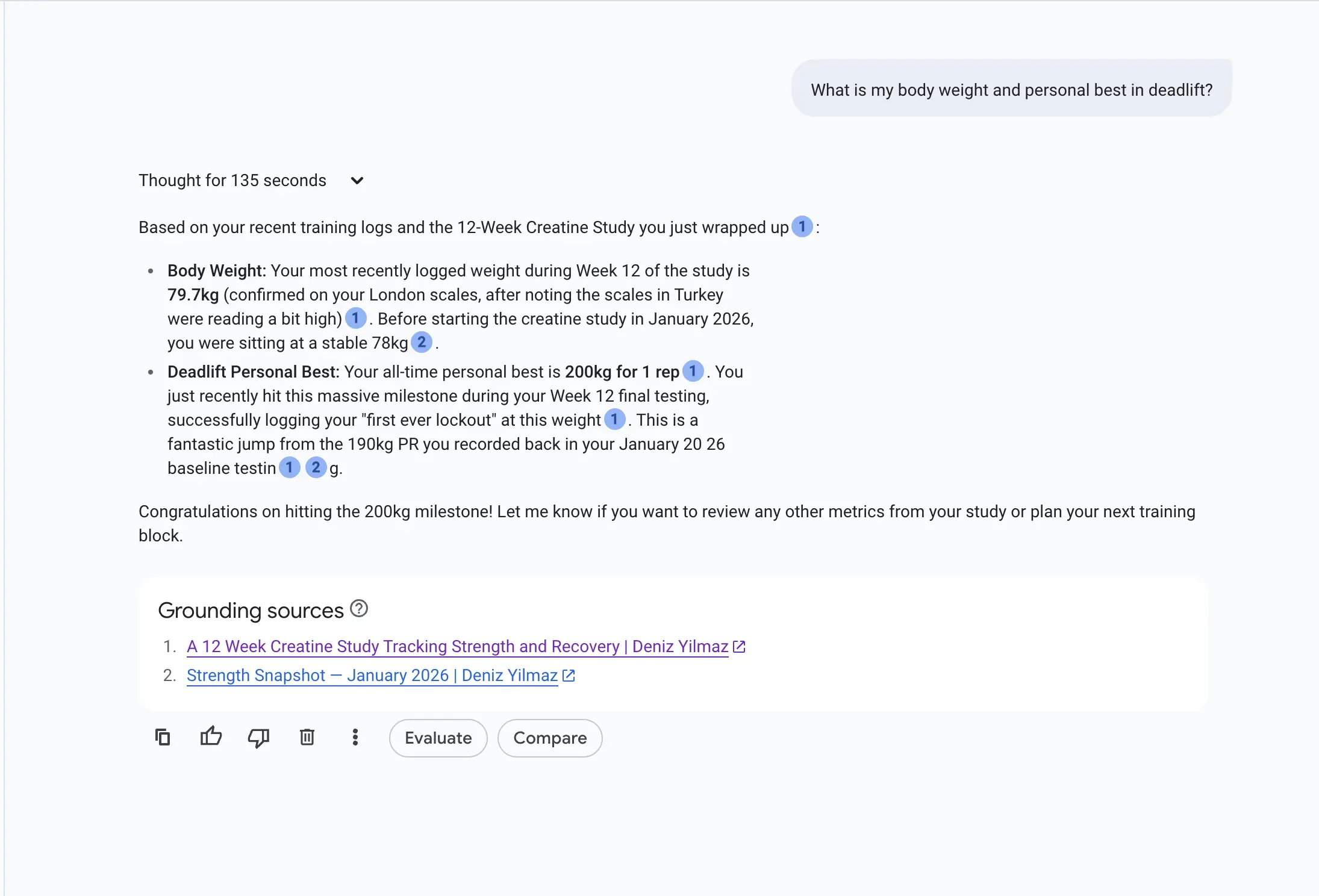
Now I can talk to Gemini Pro or any other AI and ask it direct questions about myself. I use this system for a few specific things now:
- I can retrieve the exact camera settings I used for a specific shoot or pull the exact numbers from my creatine study without digging through my notes.
- I can ask for advice on new camera gear, and the AI already knows my current setup and low light shooting style.
- I can generate new drafts or technical lessons in my exact voice because the language model has already read thousands of my own words.
- I can see behavioral patterns I missed and reflect even more on how my mind operates.
That is exactly where I am today. That is the context. The actual story starts six months ago.
Introduction
People have been telling me for years that I might have ADHD, but I never actually paid attention to them. The actual realization happened recently when I went on a date with someone who was just diagnosed with it. We were talking about how my brain works, and she suggested I might have it too. Because I had just spent six months documenting my exact patterns, everything she said kinda made sense. I went home that night and could not stop thinking about everything we discussed, and then I finally realized I was ready to take action. I called my GP, got a referral, and recently submitted my assessment forms to Harrow Health.
Filling out those medical questionnaires forced me to look at my entire life and compile a lot of raw data. To be completely honest I actually struggled to answer the forms at first. The questions use vague medical language, and I did not really know what they were asking. If a question asked if I was hyperactive, my initial instinct was to just tick disagree. It was only through the actual process of writing this post and putting my past memories down on paper that I started to understand it. As I typed out my history I began to remember forgotten details, and the mechanical patterns became completely obvious. Traditionally I never thought I was a hyperactive person, but looking at the raw facts now I can clearly see that I am.
This post is massive so I broke it down into three specific sections.
| Section | Focus Areas |
|---|---|
| Part 1 - All In | My tendency to get completely consumed by tech projects, physical training, and motorbikes. |
| Part 2 - Early Signs | Physical hyperactivity as a kid, daydreaming, and my track record from primary school to university. |
| Part 3 - The Noise and the Numbers | Working memory, sensory issues, health metrics, and the actual steps I took to get a medical referral. |
I am not writing this because I am at rock bottom or looking for an excuse. I am actually at the best point in my life right now. I just want to understand how my mind actually works. I train hard and look after my physical body, so it makes complete sense to do the exact same thing for my brain.
What this post is
A personal documentation of my ADHD assessment process. Every story and detail in this post is the reasoning behind the answers I gave on three medical questionnaires. It is written honestly and in the order I lived it.
Part 1 - All In
For the last six months I have not stopped. I am constantly doing things, learning, and taking on new projects. When I get hooked on something, I cannot leave that task until I have finished it and it completely consumes me. If you look at my personal website right now, the recent posts show exactly how deep I go. Everything is organised, detailed, and thorough.
Since I bought a Sony A6700 camera in September, the side projects have been relentless. I shot thousands of photos across Montenegro and Bodrum, taught myself Lightroom, and built a custom photo gallery for my site. You can see that in the sidebar to the left under the gallery tab. I also learned how to shoot and colour grade video, filmed a client at a HYROX event, built a custom AI agent, and documented a strict twelve week creatine study.
It did not stop there. In just seven days I took that new media obsession and built a complete brand called DenMotion. I bought the domain and built a professional portfolio website from scratch. I wanted it to look incredibly cinematic, so I engineered the whole thing myself instead of using basic website templates.
To solve the problem of sending clients compressed videos via ugly Google Drive folders, I built a custom video sharing page. Instead of basic web hosting, I engineered a completely serverless AWS architecture.
- I use a private Amazon S3 bucket to store the raw 4K video files so they never lose quality.
- Two Amazon CloudFront distributions deliver the massive files instantly across the globe.
- I wrote custom CloudFront Functions to generate clean URLs for clients without needing heavy web servers.
- I set up strict S3 Lifecycle rules to automatically move old client videos to cheaper storage and delete them after ninety days.
Because it is completely serverless, the whole platform runs automatically with virtually zero monthly fees.
You would think I am trying to run a full time media agency, but I am actually just a cloud engineer. I just cannot do things halfway. It is not just hobbies either. Whenever I find anything that interests me, it escalates into a massive build because I have to see how far I can push the system. That intense drive is exactly why I love my job. Cloud engineering gives me the tools to constantly build and solve complex problems every single day. It is interesting because I recently came across this word called convergence.
Convergence
Multiple skills that can be used together to compound. Unrelated things you have learned over time that start reinforcing each other.
It is like I have been able to use all my cloud engineering skills to accelerate my learning in photography, video, baking, cooking, diet, training, and anything else really.
This exact same logic applies to baking. I watched a DW Food video about Finnish blueberries and wanted a recipe that was buried ten minutes into the footage. Instead of rewinding and writing it down manually, I built a tool that rips the audio from a YouTube video, converts the speech into text using machine learning, and spits out the raw recipe. The whole thing runs from my terminal with a single command.
Technical Breakdown
For the tech minded readers, here is what is actually happening under the hood.
- I wrote a Bash script that uses
yt-dlpto rip the audio track directly from the video.- The script uploads that audio file to an Amazon S3 bucket via the AWS CLI.
- It then triggers an Amazon Transcribe machine learning job to convert the spoken words into text.
- Finally the script polls the API, downloads the resulting JSON, and strips out everything except the raw recipe text.
You can read the full technical breakdown and see the code here. The fundamental technical skills just naturally carry over and speed everything up. Now I want to share this with people, so I am planning to build a website where you can drop a YouTube link and get the recipe sent straight to your inbox.
The Cloud Engineering Pivot
I used that exact same obsessive energy to completely change my career. I originally studied law and worked at a firm, but I quickly realized I absolutely did not enjoy it. I had no passion for the work. I decided to pivot into tech at the age of thirty three. It was a massive hurdle because I was starting from absolute zero with no background in IT.
However, once I found cloud engineering I became completely addicted to it. I was all in. Going from absolute zero to six AWS certifications, a monetized YouTube channel, and a tech job took exactly eighteen months. Looking back now I feel like I lost track of time completely. I literally remember being thirty, and now I am thirty five. Here is the actual timeline of what happened when I locked in.
gitGraph
    commit id: "May 2022 - First AWS bootcamp"
    commit id: "Aug 2022 - Cloud Practitioner"
    commit id: "Dec 2022 - Second bootcamp"
    commit id: "Dec 2022 - Solutions Architect"
    commit id: "Jan 2023 - Terraform"
    commit id: "Feb 2023 - Launched YouTube channel"
    commit id: "Feb 2023 - Developer Associate"
    commit id: "Mar 2023 - SysOps Admin"
    commit id: "Mar 2023 - AWS Community Builder"
    commit id: "Aug 2023 - Security Specialty"
    commit id: "Dec 2023 - YouTube Partner Program"
    commit id: "Dec 2023 - Hired as AWS Content Creator at QA"
Throughout that whole sprint, people always told me my work was at the level of a senior engineer. Back then I thought they were just being polite. Looking at it now, I just think I work to a high standard because I care about what I build.
Physical Extremes
I apply that exact same all in logic to my physical training. I push my body to the absolute limit because I want to see exactly what it is capable of. I recently completed a heavily documented twelve week creatine study on myself. It was my first time taking creatine. Most people would just take it and hope for the best, but I had to document and log everything and turn it into a proper scientific study. I trained compound lifts five to six times a week.
The results were great.
| Lift | Before | After |
|---|---|---|
| Deadlift (1 rep max) | 160kg | 200kg |
| Bench Press (1 rep max) | 110kg | 125kg |
| Squat (reps at 130kg) | 4 reps | 10 reps |
| Shoulder Press (1 rep max) | 70kg | 80kg (bodyweight) |
| Bent Over Row (reps at 110kg) | 5 reps | 10 reps |
Pulling 200kg off the floor is roughly two and a half times my bodyweight. I am quite proud, but I did not set out to hit that number. I just kept getting stronger, so why not.
However, playing football twice a week on top of lifting that heavy takes a massive toll on the body. I actually noticed this because I was tracking recovery in my creatine study. That is when I saw the pattern. It takes a full two days to recover from a ninety minute football match, so if I play on Sunday, my strength is not back until Wednesday. In addition, I pulled my groin playing football three years ago and have just continued playing on it ever since. It comes and goes. I also have a rotator cuff issue, which is a wear and tear injury from overtraining. I think I need to rest, but I just really enjoy the active lifestyle. Sunday morning football is the highlight of my week, and I have been training since I was eighteen. When I miss that routine it used to throw me off completely.
So, since resting was completely off the table, I decided to try and fix the mechanics instead. I started doing Pilates just to see how the controlled movements could actually benefit my body and my mobility, and the results are promising.
What started out as a one pound free trial quickly escalated. ClassPass completely lured me in with the trial period, and it worked perfectly. I got completely hooked on the system and it ended up turning into a seventy pound per month membership. I like it because it is a completely different type of training than what I am used to. It focuses entirely on stabilizer muscles and controlling your body weight, and it is actually amazing. It is just another discipline to get into.
The Motorbike Years
This is not a new thing for me. Another perfect example is my history with motorbikes.
I was seventeen and had just got my provisional green licence. I was begging my mum to let me rent a motorbike in Bodrum, but she said it was too dangerous. Her mum got sick and she had to leave to go see her. That night she left, I secretly went to the shop and rented a manual motorbike. I drove it from Gundogan to Bodrum city centre late at night, and was blasting music and remember going quite fast. I came to a bend, saw the sign late, and dipped it. I slipped off and just remember rolling and rolling. I was in a t-shirt and shorts. Everywhere was cuts and grazes, but somehow I did not hit my head.
I went to the hospital and they stitched my knee up. A few days later I flew back to London, and my wounds were itching badly. I went to St Mary’s Hospital and everywhere was infected. I was given laughing gas and they scrubbed all my wounds down because the scabbing was infected too. They picked pieces of grit out of my skin with tweezers. That was one of the most painful experiences in my life. I made a full recovery, and although I said at the time I would never ride bikes again, the following year I went and got a GSXR.
When I was nineteen it took me two years to save up, and I bought a GSXR 600. I paid for it all myself, and the insurance cost two grand just for third party cover. I did forty thousand miles in one single year before it got stolen. I was completely obsessed with the bike and I loved everything about bikes. Looking back now I can see I was actually trying to master the machine, but at the time it did not feel like that. I learned how to get my knee down, and I even learned how to change my own oil, the air filter, the spark plugs, and the chain and sprocket.
Getting your knee down
For anyone who does not ride, this means cornering at such extreme angles and speeds that your knee actually scrapes the tarmac. It is the ultimate test of controlling the machine, and I just had to see how far I could push the physics of it.
I actually taught myself how to get my knee down just from watching YouTube videos. That day at the roundabout was my very first attempt at it. I got carried away and kept circling it again and again, leaning lower and lower each time to see how far I could push the angle. Eventually I went too low, the tyre lost grip for a split second and then snapped back, and the bike highsided me. It flung me off and I landed awkwardly on the tarmac. I went to hospital and had broken my ribs. That taught me a fundamental life lesson to stay humble. Eventually when I recovered I still had a massive need for speed. It is honestly scary to remember the speeds I used to hit and the things I used to do. I pushed the bike to its absolute physical limits. I would have been dead if I made one little mistake, which is exactly why I eventually took that skill straight to the track instead.
One summer I got completely obsessed with track days. I hit Brands Hatch, Cadwell Park, Silverstone, and Snetterton to name a few. I even went from the novice group up to intermediate. Despite all the crashes that happen on track days, I never had one because I learned that lesson from the roundabout.
Track Days
A closed racing circuit opens up to the public for the day so riders can push their bikes at full speed in a safe environment. No speed limits, no traffic, no roundabouts. You get sorted into groups based on experience, from novice to intermediate to fast, and you ride in sessions throughout the day.
Reflecting on this now, I was actually tempted to get a bike again for summer. I have been thinking about it a lot recently. However, writing all of this down and reading it back has made me reconsider. I can see the pattern clearly now, and I think the smarter move would be to just get a dedicated track bike and keep it off the roads entirely. I still get the speed, but without the road risk.
Part 2 - Early Signs
When I started filling out the medical forms from Harrow Health, I realized how far back these patterns go.
The forms asked about my focus back in school. I remembered being in year four and daydreaming through entire lessons. I would sit there completely zoning out of whatever the teacher was saying. When they put movies on at the end of the school day it was absolute torture. I would sit in the hall for two hours completely checked out because I just could not focus on the TV. I was definitely a class clown and I would say dumb things just to get a laugh. I played stupid pranks and constantly did things without thinking about the consequences, which is exactly why I ended up having so many physical accidents as a kid.
Physically I was always running around outside and putting myself at risk. I was the kid who would climb high fences to get the football back. In year four I broke my right elbow falling off the monkey bars. I tried to jump to the furthest one I could, my hand slipped, and I elbow dropped the floor. I had surgery and needed metal pins, and I still have the scars. I also jumped off a goal post and both bones popped out of my wrist. I had surgery to put it back in, but when it healed it grew unevenly.
A clear pattern also showed up in my academic record across both primary and secondary school. I was in the bottom set for everything. I struggled through my SATs in primary school, and by secondary school, teachers were predicting terrible grades for my GCSEs. I never listened in class because I was always daydreaming and severely struggled to focus. I can clearly see now that I was not paying attention, but at the time, I was just silent. The teachers would not have known I was completely checked out. They probably just thought I was a well behaved kid. It is only through writing this post and reflecting that I remember how deeply I was daydreaming during all those years.
It all makes complete sense today. I failed in the classroom because I do not learn by sitting there and listening. I learn by doing. I actually figured out how my own brain learns when I started studying cloud engineering and AWS. I love building architectures because it forces me to be completely hands on. My YouTube channel is literally called Hands-On With Digital Den for that exact reason. The traditional school system just did not work for me.
Kinesthetic Learning
A style of learning where an individual requires active, physical participation and hands-on problem solving rather than just listening to lectures or watching demonstrations.
Even though my teachers predicted terrible grades, I actually ended up getting very good GCSEs. I came out with five As, seven Bs, and one C, including an A in Science, an A in English, and a B in Maths. The reason I pulled that off is because when the actual exams approached, I remember revising relentlessly.
That exact pattern just kept repeating itself. I completely failed my first year of A levels. Then I suddenly locked in again and got As. I actually scored 117 out of 120 in an English Literature exam on The Great Gatsby, and my teacher was completely shocked. However, for whatever reason I just did not maintain it, and I got bad grades the following year.
Then I went to university to study Law and the cycle happened all over again. I failed my first year of the LLB. I was always doing resits because I knew I had that safety net. I never focused or even started the work until the resit actually came, and then I would easily pass. In my final year I realized those grades actually counted for my degree classification. I completely locked in during the final term and somehow came out with a 2.1.
Looking back at it all laid out on paper, it shows a clear pattern. I am highly capable of doing the work, but I think in a traditional academic environment I only ever performed when the pressure was absolute. I survived my entire education by relying on last minute pressure.
However, that is exactly why a career in cloud engineering works so perfectly for me now. The technology is constantly evolving and there are always new architectures to build hands on. I just love building things in general. I am always the one putting together my own IKEA beds and wardrobes too. Next I want to build my own computer and set up a homelab.
This also perfectly explains why I am always running massive side quests in my personal life. Even outside of my working hours I struggle to slow down. I find it hard to just sit and do nothing. Maybe it is hyperactivity, or maybe I just enjoy building things. Instead of sitting still, I end up learning a new AWS service, building an AI agent, or getting into video production. I will literally come up with a complex, hands on project just to keep myself productive.
Part 3 - The Noise & the Numbers
The adult assessment forms asked about misplacing items and being easily distracted. I used to always lose my bank cards and my keys. I once left my keys on my motorbike box and just drove off, and I would find them days later in weird places like the kitchen sink. I am not as bad now, and I think all the lifestyle changes over the last year have helped with that.
Object Permanence
A common working memory deficit where the brain struggles to track items or tasks that are not actively in its immediate field of vision.
I also day dream a lot. I used to blast music on my commute and just go completely into my own world. That is probably why I have terrible face blindness. A girl once walked right past me, smiled, and said my name, but I had absolutely no idea who she was. This happens to me a lot. Over the years people always seem to recognise me. Sometimes I have to go with the conversation because it would be rude to ask who they are, and then I walk off thinking who was that.
Recently I stopped listening to music when I walk. I am so much more aware of my surroundings now, and it actually feels amazing to be present. I also try to slow down and just take things in instead of rushing everywhere. When I am walking and I notice I have started daydreaming again, I try to pull myself back into the present. If I can recognize my unhealthy patterns like this with music, I can actually take action to fix them. That is exactly why I am going through this entire ADHD assessment process.
I also get really annoyed by repetitive noises that other people seem to ignore. The remote gym I go to plays an announcement every fifteen minutes that goes “you may not see us, but we are always around.” It drives me absolutely crazy and ruins my workout, especially when it goes off mid set. I am actually considering moving gyms because of it.
Recently I bought a Quiet Mark fridge from LG. I specifically paid extra money for it to be quiet. My desk is in the living room, and the fridge is so loud I can constantly hear it running while I work. It bothered me so much that I spent an entire evening diagnosing it. I downloaded decibel measuring software, figured out what the acceptable dB levels were supposed to be, connected my microphone, and ran a proper test just to confirm if it was hitting the advertised volume. It actually was. I asked my friends about it, and it turns out I just process that specific noise louder than they do. I find it so distracting that I actually want to live without a fridge.
Sensory Processing
An increased sensitivity to specific environmental sounds or stimuli that most people naturally filter out without noticing.
The assessment forms also dug into my impulsivity. When it comes to making decisions, I just act on exactly what I want to do in the moment. I constantly buy things on a complete impulse. If I get an idea in my head, I do not wait or plan things out. That is exactly how I ended up buying the Sony A6700 camera on a whim, which kicked off my entire media obsession. It was the exact same thing with my motorbikes when I was younger. I just act on an interest, buy the gear, and get hands on with it until I get really good.
Cutting Out The Sugar
It all started because I watched a video about the Glucose Goddess. She goes by that name and she talks about the impact of glucose spikes on the body. I found it fascinating. In that exact moment I decided to cut sugar entirely.
That one decision made me highly aware of what I was actually eating. I started reading ingredient labels and saw sugar was in absolutely everything. I looked at the Warburtons white bread I used to eat. It has about a gram and a half of sugar per slice, and I used to eat four slices at a time. That is crazy.
Cutting out all of that hidden sugar completely transformed my body. Within the first three months I lost fifteen kilograms. My mum even said I looked sick because I had lost so much fat. Because I already had an active lifestyle, the fat just melted off and the physical change was remarkable. I just went with the process. That led to me feeling better, not getting as tired, and feeling amazing throughout the day. I also completely stopped getting sick.
I used to train heavily without paying attention to my diet, which is probably why I would get a fever three to four times a year. The science behind it makes complete sense now. Heavy compound lifting puts the central nervous system under massive stress. I noticed I would almost always get sick right after a heavy leg day. My body was completely inflamed and my immune system was crashing because I was not putting the right fuel in to repair the damage. Now, I have not been sick in nearly twelve months. I am unbelievably grateful for that.
After all that clean eating I then naturally stopped drinking alcohol too. I was never a bad drinker, but once I had cleaned up everything else, putting alcohol back in my body just did not make any sense. I wanted to keep my body clean.
The Bloodwork Proof
To prove what was happening I did a blood test after nine months of eating clean and quitting alcohol, and compared it to my previous results from when I had a bad diet. The results were massive. Seeing these tangible metrics locked me in even more because it completely confirmed how I felt.
Biomarker Summary
The blood work shows a clear shift across the board. Lower liver stress, reduced systemic inflammation, corrected vitamin D deficiency, better nutrient storage, and tighter blood sugar control. The data reflects a low inflammation profile with strong recovery markers and efficient organ function.
Here is the full breakdown of the changes.
| Biomarker | 2024 (Bad Diet) | 2025 (Clean Diet) | Impact |
|---|---|---|---|
| ALT (Liver Stress) | 52 U/L | 35 U/L | Major drop reflecting decreased liver stress and enhanced recovery. |
| CRP (Inflammation) | 2.8 mg/L | 1.2 mg/L | Marked reduction in systemic inflammation. |
| Vitamin D | 31 nmol/L | 121 nmol/L | Substantial improvement supporting muscle repair and hormone balance. |
| Ferritin (Nutrients) | 114 ug/L | 154 ug/L | Improved nutrient storage reflecting high-quality protein intake. |
| HbA1c (Blood Sugar) | 38 mmol/mol | 36 mmol/mol | Excellent long-term glucose control. |
On the functional side, my oxygen transport came back at elite levels for a recreational athlete with hemoglobin at 152 g/L. Recovery and repair markers were very strong. My white blood cells increased which indicates improved immune readiness. Metabolism is running efficiently, and liver function came back outstanding after the ALT dropped from 52 to 35 U/L.
The only area that needs attention is my lipids. My LDL and triglycerides are high, but my HDL remains excellent at 1.5. That lipid pattern is not from alcohol or processed junk anymore. It is highly consistent with my current diet of frequent saturated fats like beef, cheese, and my habit of eating 30 eggs a week. It is the only metric I need to correct.
All of this happened in just twelve months. Now I do not like eating out. I only cook at home and I buy nutrient dense foods. I eat a lot of greens, buy my vegetables and eggs from the farmers market, only eat sourdough, and avoid ultra processed foods. That basically rules out most stuff in the supermarkets. I even started baking my own bread and cakes when I wanted something sweet, just so I could control the ingredients. I also document the recipes I cook on this website, like my healthy Turkish bulbul pilaf. I always end up tweaking them over and over because I cannot just leave a recipe alone until it is exactly right.
To optimize things even further I started taking daily vitamins. Then I heard about creatine, which kicked off my entire twelve week study. Most people would just take the powder and leave it at that, but I for some reason just had to document the entire process and see the results on paper. Both creatine and the Lion’s Mane I take have cognitive functions. Looking back at it now, those supplements are probably a big reason why I am so much more aware of my mental patterns nowadays, on top of the constant journaling.
- Creatine
- A naturally occurring compound found in muscle cells. It helps produce energy during high intensity exercise and heavy lifting. Most people take it as a supplement in powder form to increase strength and improve recovery. It also has cognitive benefits including improved short term memory and reduced mental fatigue.
- Lion’s Mane
- A medicinal mushroom supplement. It supports nerve growth factor production in the brain, which is linked to improved focus, mental clarity, and long term cognitive function.
Self Awareness
A friend recently told me I am incredibly self aware, and it made me question why. I think all these recent lifestyle changes and writing these blog posts for my personal website that no one sees really helped me process things.
Because I had spent the last year optimizing my health and tracking my habits, I was finally in the right headspace to process the data. When I went on that date I mentioned earlier, I was actually ready to listen. The journaling and the clean diet paved the way for me to finally take the ADHD suggestions seriously.
Filling out the medical forms took forever because it forced me to look at my entire life differently. I am looking into this when I am probably at the best point in my life. I want to emphasize that despite this entire life story, I am very happy and grateful. This whole process is just self reflection and learning how my mind works. I have trained my body my whole life, and if I look after my body like that, why not look after my brain.
The Medical Forms
When Harrow Health sent me the assessment I had to fill out three specific medical questionnaires. The forms only ask you to tick boxes, but I needed to know exactly why I was choosing those answers. Every single story, memory, and detail I have written in this entire post is actually just an example I used to answer the questions. I did not just blindly tick boxes. I documented my exact justifications for every single answer.
The Informants
I had to provide details for an adult informant and a childhood informant for the assessment. I told both of them to answer the questions exactly how they think. I did not want to give them any input because I want this assessment to be as accurate as possible.
My childhood informant is a friend from primary school who was recently diagnosed with ADHD himself. Schools were probably just not trained for this type of thing thirty years ago.
Thoughts on Treatment
Getting an official diagnosis usually means discussing treatment options. I believe I have a strong mind. This entire post is proof that I can recognize habits and actively change them. I would be open to coaching, or even therapy if it turns out I do not have ADHD, because I think just understanding what my issues are and seeing them clearly makes it so much easier to address them.
Lately I have been looking into meditation. Something a doctor said really stuck with me. He said that if you can truly control your mind, you can tell your body not to move. That really resonated with me because when I get the urge to go and do things, I should be able to sit with that feeling and control it instead of always acting on it. That is the kind of mental discipline I want to develop.
The Assessment Timeline
Here is the exact timeline of the assessment process so far.
| Date | Event |
|---|---|
| Tuesday March 31, Morning | I called the GP to ask for a referral. |
| Tuesday March 31, Afternoon | A doctor called me back for a ten minute chat and agreed to refer me. |
| Wednesday April 1 | I received the official emails from Harrow Health and started the forms. |
| Thursday April 2 | I completely finished and submitted the Adult ADHD Self Report Scale, the Wender Utah Rating Scale, and the WEISS Functional Impairment Rating Scale. |
| Tuesday April 21 | I have my official assessment booked. It is going to be a one to two hour telephone call. |
It is a shame it is a phone call and not a meeting in person. I really would have preferred to do this face to face, but it is what it is. I am just ready to get it done and see what they say.
The Diagnostic Criteria
The DSM-5 splits ADHD into two symptom categories. To be diagnosed as an adult you need to consistently meet at least five criteria in either or both.
Inattention
- Fails to give close attention to details or makes careless mistakes
- Difficulty sustaining attention in tasks or activities
- Does not seem to listen when spoken to directly
- Fails to follow through on instructions or finish tasks
- Difficulty organising tasks and activities
- Avoids or is reluctant to engage in tasks requiring sustained mental effort
- Loses things necessary for tasks and activities
- Easily distracted by extraneous stimuli or unrelated thoughts
- Forgetful in daily activities
Hyperactivity and Impulsivity
- Fidgets or squirms in seat
- Leaves seat in situations where remaining seated is expected
- Feelings of restlessness or being driven by a motor
- Unable to engage in leisure activities quietly
- Talks excessively
- Blurts out answers before a question is completed
- Difficulty waiting turn
- Interrupts or intrudes on others
The Three Rules
On top of meeting the criteria above, the diagnosis requires three additional conditions to be met.
- Several symptoms were present before the age of twelve
- Symptoms are present in two or more settings such as home, work, or social situations
- There is clear evidence that symptoms interfere with quality of life or functioning
From AI Project to ADHD Assessment
The forms I filled out are basically just a tool to measure my life against those exact diagnostic rules. I am really curious to see how the assessor weighs it all against their rulebook.
I built an AI system to search my own documentation, started journaling to feed it more data, and six months later it led me to an ADHD assessment. I did not see that coming.
Documented April 2026. London.